The Velvet Rocket

Entries from January 2010

T. E. Lawrence’s Brough Superior SS100 Motorcycle, 1932

January 31, 2010 · 1 Comment

This 1000cc motorcycle was the prized possession of T E Lawrence, better known as ‘Lawrence of Arabia’, and the machine on which he was killed in May of 1935. Lawrence’s Brough Superior was tailor-made by George Brough himself and cost 170 pounds in 1932. This was the seventh Brough that Lawrence had owned. He named each in succession ‘George 1′ to ‘George VII’, and also referred to some of them, including this model, as ‘Boanerges’ (Son of Thunder).

The Brough Superior was the fastest and most expensive machine on the road at the time. It easily reached speeds of over 100 mph and was at the cutting edge of 1930’s design. The motorcycle was Lawrence’s constant companion on the deserted country roads of pre-war Britain. Long distance visits to friends such as Winston Churchill or Lady Astor were achieved in record time. ‘It is the silkiest thing I have ever ridden…’ Lawrence would famously say.

In May 1935 Lawrence was riding the Brough back home from Bovington in Dorset to his nearby cottage at Clouds Hill. Suddenly he came upon two errand boys on bicycles, swerved to avoid them and pitched over the handlebars onto the road. His head struck the ground and he sustained terrible injuries, which would claim his life six days later. The motorcycle was only slightly damaged in the accident and was returned to the factory to be repaired by George Brough.

T. E. Lawrence's Brough Superior SS100 Motorcycle

T. E. Lawrence's Brough Superior SS100 Motorcycle

T. E. Lawrence's Brough Superior SS100 Motorcycle

T. E. Lawrence's Brough Superior SS100 Motorcycle

This is a clip from the opening of the film Lawrence of Arabia that depicts T.E. Lawrence racing through the English countryside and ultimately crashing as described above. It’s a good sequence and worth watching. Just skip ahead to around 4:30…

Categories: Speed
Tagged: , ,

Oliver Cromwell’s Death Mask

January 31, 2010 · 1 Comment

Oliver Cromwell died at Whitehall on September 3rd, 1658. His death mask is on display in the Museum of London.

The death mask of Oliver Cromwell on display at the Museum of London

He was buried in Westminster Abbey, but when the Royalists returned to power his corpse was dug up, hung in chains, and beheaded.

His measures against Irish Catholics have been characterized by some historians as genocidal or near-genocidal, and in Ireland itself he is widely hated.

Categories: Miscellaneous
Tagged: ,

S/V Legend

January 30, 2010 · 1 Comment

The sailing ship "Legend" now based in Norway

1915 – Built in Scheveningen as a sailing trader/fishing vessel

1917 – During World War I she is reported missing in the English Channel

1925 – Found abandoned in the Congo River by a Scheveningen fisherman who brings her back to the Netherlands

1928 – First engine installed

1926-1940 – Operates mostly as a cargo ship in the northern seas

During World War II, she is involved in running arms for the Norwegian Resistance.

1944 – She is once again reported missing

1947
– This time she reappears in Newfoundland. No trace is found of the crew or what/where she has been for the past three years.

After being brought back to the Netherlands she resumes operating as a cargo ship.

1955 – Sold to Norway

Spends the next 40 years along the Norwegian coast as a cargo and fishing ship. Also makes many voyages to Iceland and Greenland

1995 – Her trading days are over and she is converted back into a sailing ship.

Now available for charter…

http://www.legend.no/

Categories: Miscellaneous · Travel To "Normal" Places
Tagged: , , , , ,

The Gun Guitar

January 28, 2010 · 1 Comment

Something that should probably be on everyone’s “must have” list… The gun guitar.

This one was in the Museo Historico Policia in Bogota, Colombia.

A functioning gun guitar in Colombia

The gun guitar

I apologize for the bad glare in the pictures, but in a building brimming with war-hardened police officers I did not think it would be prudent to smash the glass on the case just to get a better picture. On second thought, maybe I should have. It would’ve been an interesting story…

Categories: Colombia · Travel
Tagged: , , , ,

Mughal Bridge – Pakistani Countryside

January 24, 2010 · 1 Comment

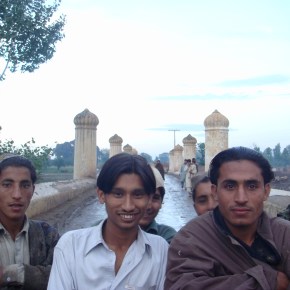
Waiting for the Khyber Pass to open up so we could make the journey into Afghanistan, we killed time by exploring the Pakistani countryside. One day on our way back into Peshawar, we came across this rather unique bridge built during the time of the Mughal Empire:

Along the edge of the river was this camp of gypsies:

Pakistan

The gypsies (pictured below) were fascinated by our presence and came out to examine us more closely.  One of the children grew bored with us, however, and while poking around the bridge uncovered a nest of poisonous snakes, which soon began slithering across the bridge in an effort to find a new refuge.  Unfortunately, the only way back to the car was through the snakes on the Mughal bridge. So, it took a fair amount of dancing around to get back inside our vehicle. 

The increased risk of a venomous bite or a twisted ankle imbues dancing with the heady cologne of menace. I’d recommend it to anyone…

Pakistan

Categories: Pakistan · Travel
Tagged: , ,

The Museo Historico Policia and Pablo Escobar

January 23, 2010 · 3 Comments

One museum definitely worth checking out in Bogota is the Museo Historico Policia (Museum of Police History) which is located just west of Plaza de Bolivar. The admission is free and allows one to see the inside of the lovely ex-headquarters of Bogota’s police force (built in 1923) as well as to review the great artifacts and items of historical significance the police force of Bogota has accumulated over the years.  You’ll be shown around by 18-year-old, English-speaking local guides that are serving a one-year compulsory service with the police.  And if you ask, you can get some solid stories out of them.

Here is the entrance to the museum:

museo-historico-policia

One of the first questions our guide asked us was if we would be interested in seeing weapons.

“OH-FUCKING-YES!!!,” I thought.

“Yes, we would indeed be interested in seeing weapons,” I said.

We were led into a large upstairs room that was completely filled with gun cases and gun cabinets containing weapons that had passed through the hands of Bogota’s police forces over the years – weapons confiscated from the hands of criminals such as these interesting specimens below:

museo-historico-policia

Or weapons used by the Bogota police themselves such as this riot gear:

museo-historico-policia

However, the really good stuff is in the basement…  And you know you’re getting to an interesting section because one of the first things you see is this massive Harley-Davidson that used to belong to Pablo Escobar on display:

A Harley-Davidson motorcycle from Pablo Escobar

In fact, they have a whole section of the museum dedicated to Pablo Escobar:

Pablo Escobar wanted poster

Inside, one can see such curiosities as this model of his bullet-ridden corpse (reflecting the plastic surgery he underwent to change his appearance during his final days on the run):

Pablo Escobar death mask

Other members of the Medellin cartel are not ignored as this flow chart below of the organization demonstrates, but Pablo Escobar is the main focus of the exhibit.  By the way, if one’s photograph rather than just one’s name appears on the flow chart, one has been arrested, or more likely, is dead as the police were not exceptionally concerned with capturing suspects alive and this is a rough business:

museo-historico-policia

These were the personal guns of Pablo Escobar… He apparently had a thing for Uzis.

Guns belonging to Pablo Escobar

And in the bottom of the display case containing his guns are some of his personal effects such as his Ray-Ban sunglasses, a Swiss watch, a video recorder, etc.

Pablo Escobar gear and ray bans

Here is the satellite phone that Mr. Escobar used:

Pablo Escobar satellite phone

The item below is particularly unique… It is a tile retrieved from the roof that Pablo Escobar was gunned down on. And if you look closely, you can still see his dried blood on the tile:

A bloody tile from the rooftop where Pablo Escobar was gunned down

This is some of the gear that was used by U.S. and Colombian forces to track Escobar through calls he made on his mobile phone:

Some of the equipment used for tracking Pablo Escobar

Pablo Escobar created and lived in a luxurious country estate and zoo called Hacienda Napoles (Spanish for Naples Ranch) and had planned to construct a Greek-style citadel near it.  However, Escobar’s estate was expropriated by the government after his death and has since been converted into a theme park.  If you wish to visit, it is one kilometer from the Colombian town of Doradal.

The web site is: http://www.haciendanapoles.com/index.php

And the phone number is: 834 2129 or 317 330 4918

If you wish to visit Escobar’s grave, he is buried in the Colombian city of Medellin at the Cemetario Jardins Montesacro.

Pablo Escobar is certainly not the only prominent drug dealer mentioned in the basement though. Also on display is my buddy, Carlos Lehder, and characters such as Jose Gonzalo Rodriguez Gacha A.K.A. “El Mexicano” and these pistols that used to belong to him – a Browning 9mm and Colt-MK .45 cal.

Pistols that belonged to Jose Gonzalo Rodriguez Gacha AKA El Mexicano

Aside from drug dealers and a section on guerilla activity, the Museo Historico Policia also houses a section on punishment. It includes such gems as this original executioner’s block and axe imported from England:

An executioner's block and axe in the Museo Historico Policia

And photographic displays such as this decapitation sequence shot in Turkey… The photographer did an apt job of capturing the blood spraying out of the condemned man’s neck:

An execution taking place by means of decapitation at the Museo Historico Policia

an execution taking place by means of decapitation at the Museo Historico Policia

I would have included a photograph of our guide in this sequence as he was quite pleasant. However, for security reasons they are not supposed to have their photos taken.

A modest memorial in the back courtyard of the museum reinforces the wisdom behind this policy. The memorial is a simple mural painted of a scene lit by starlight.

I asked the guide if each of the many, many stars represented a police officer killed in the line of duty.

“No,” he responded quietly, “each star represents 100 officers killed.”

Categories: Colombia · People · Travel
Tagged: , , , , , ,

The Barrios Of Caracas, Venezuela

January 20, 2010 · 2 Comments

I didn’t quite know what to expect out in the barrios of Caracas, but I knew I wanted to visit them.  I did know that the crime statistics in Venezuela are astronomical, and especially so out in the barrios.  And I knew that most of the supporters of Chavez come from these neighborhoods.  But, that’s about all I knew and that isn’t much.  So, that was enough to convince me that the barrios merited an investigative visit.  And what nobler cause can there be than dispelling one’s own ignorance?

Robert Young Pelton is currently soliciting input on places to visit for DPTV (Dangerous Places TV) and, upon our return, I noticed that the barrios of Caracas had been suggested.  Shortly after, I read elsewhere that the Caracas barrios are considered one of the most dangerous places on the planet.

Hmmmm, I just took my wife there… I didn’t know it was that bad.

They are certainly interesting neighborhoods.  And, yeah, I did feel the “I need to get the fuck out of here” vibe a couple of times – particularly after snapping a picture of some local drug dealers that really didn’t appreciate having their portrait taken.

By the way, if you have any suggestions for Mr. Pelton, he is still actively soliciting ideas

Inside the Caracas barrios:

The barrio neighborhoods of Caracas

Inside the barrios of Caracas

A scene from the Caracas barrios

The Caracas barrio

The barrio in Caracas

But, as with everywhere else I have visited that has a bad reputation, you’ll find that most people are friendly…

A fruit vendor in the barrios of Caracas

A poor neighborhood in Caracas

…and that it is mostly business as usual.

Business as usual

Categories: Travel · Venezuela
Tagged: , , , ,

Valle de Cocora, Colombia

January 20, 2010 · 3 Comments

In a country full of beautiful landscapes, the Valle de Cocora still stands out.  The valley stretches east of Salento into the lower reaches of Parque Nacional Natural Los Nevados, with a broad, green valley framed by sharp peaks.  Everywhere you’ll see wax palm, the largest palm in the world (up to 60 meters high) and Colombia’s national tree.

First stop on your Valle de Cocora tour will be this ramshackle settlement named Cocora where you can visit a trout farm or pick up some snacks and/or drinks.  You can get to Cocora easily by hiring one of the men with a jeep that hang out in the main square of Salento to take you there.  And you would be amazed by how many people can fit on a jeep.  The jeep we rode back to Salento in had eighteen people on and in it.  Yes, eighteen people on a jeep smaller than a Jeep Wrangler.

The specific hike we took was to the Reserva Natural Acaime.  As you arrive in Cocora the start of this trail is on the right-hand side (right across from the jeep in the picture below).  There is also a small sign next to a blue gate indicating the trail. You’ll know you are headed the right way if you go down past the trout farm.

Valle de Cocore

The first part of the trail is through grassland and wax palm.

Valle de Cocora

This dramatic rock outcropping is Cerro Morrogacho.

Valle de Cocora

Valle de Cocora

Valle de Cocora

The second part of the trail is through cloud forest.

Valle de Cocora

Valle de Cocora

Valle de Cocora

Valle de Cocora

Valle de Cocora

One unfortunate drawback of the Valle de Cocora trail is the large volume of local horse traffic.

Valle de Cocora

This has, in places, converted the trail into a morass of sucking mud in which you can quickly sink up to your knees. Make your own trail in such areas.

Valle de Cocora

Valle de Cocora

There are some extraordinary flora and fauna displays to be found in the jungle – such as this leaf that I thought looked like a reptile’s skin.

Valle de Cocora

Valle de Cocora

Valle de Cocora

About 1 kilometer before you reach Acaime, you’ll come to a fork in the trail.  The trail to the left leads to the La Montana ranger station and the one to the right goes to Acaime.

Here at Acaime there are basic accommodations and you can get food and hot chocolate (with cheese) here.  You’ll also see plenty of hummingbirds feeding.

Valle de Cocora

Valle de Cocora

Valle de Cocora

Valle de Cocora

Valle de Cocora

Valle de Cocora

Valle de Cocora

We got back to Cocora just as it was starting to get dark and I thought the moon rising over the wax palms was a great way to end the hike.

Valle de Cocora

We had been warned of guerilla activity in the Parque Nacional Natural Los Nevados which got my hopes up for some excitement, but we saw no evidence of their presence.

However, this military patrol moving over the trail we had just come down led me to believe that the guerilla activity might indeed be more than just hype.

Valle de Cocora

Valle de Cocora

Valle de Cocora

Categories: Colombia · Travel
Tagged: , , , ,

A Banana Plantation In Chuao, Venezuela

January 19, 2010 · 2 Comments

Behind the tiny Venezuelan beach village of Playa Chuao is a massive banana plantation. For some reason this fascinated the Italian and me. And so, when we disembarked from a fishing boat we had hired to take us to Playa Chuao, we walked right past the beach and the small village and into the banana plantation to check it out.

The colonial town of Chuao, a few kilometers inland, is known for producing some of the world’s best cacao, but we were interested in bananas.

The road inland through the banana plantation:

cuao-banana-plantation

This is how the locals get to work in the plantation. And you’re welcome to catch a ride yourself if you want one:

cuao banana plantation in venezuela

Banana trees:

A banana plantation in Chuao, Venezuela

banana tree in chuao

I’ll bet you didn’t know bananas grew on something that looks like this, did you?

The areas not planted over with banana trees are quite dense which helps keep moisture in the air and to keep the overall temperature of the valley lower:

The water that isn’t delivered to the bananas via rain comes from this river through a complex system of irrigation channels:

Rows of young banana trees ready to be planted:

We walked for over an hour through the banana plantation and still there was no end in sight.

Aware of the fact that every step we took forward in the oppressive heat was one we would have to take back, we eventually turned back after crossing the river.

Categories: Travel · Venezuela
Tagged: , , , ,

Is It A Dog Or A Sheep?

January 19, 2010 · 1 Comment

Or something else? Like a dogsheep?

It was friendly whatever it was…

Categories: Colombia · Travel
Tagged: