Monthly Archives: May 2008

Empire Creek Trail – Rattlesnake Peak Failure…

At the Velvet Rocket we feel compelled to review our failures and not just to trumpet our, ahem, frequent successes…

It was with a high level of optimism that Molly, Honey and I set off for some exploring of the High Sierra above Downieville, CA. Our destination? Chimney Rock.

It was a lovely day in Downieville and we enjoyed an excellent lunch:

Before heading up this road toward Chimney Rock:

So far, so good… And the road was fun to drive on. All was going well until we got to the top of the ridge and were confronted by a massive snow drift across the road – many miles from the trailhead… It would have taken a tank to get through the snow and so we had to regroup for:

Attempt # 2… Being flexible and adaptable, I soon figured out an alternate road we could take to reach our destination. This road was much closer to the Sierra Buttes (pictured below) and after some initial success, we were again turned back by high snow levels at the ridge – this time even farther away from our destination:

Accepting that Chimney Rock was not going to happen on that particular day, I reviewed my maps again and came up with Rattlesnake Peak – reached via the Empire Creek Trail…

The start point for the Empire Creek Trail is reached by splitting off from Highway 49 in Downieville and then travelling on Upper Main Street for approximately half a mile past the town post office. Cross the Downie River bridge and continue 4.2 miles to a well-defined road fork. Take the left fork (marked Dead End), passing under the tall gates marked “Empire Ranch.” Continue 2 miles to a sharp 180 degree turn in the road. At this point there is a sign reading “Red Oak Road” and “Empire Creek Trail” pointing to the narrow road on the right. Take this narrow road 1.6 miles to to Red Oak Creek.

One can drive to the trailhead, but I stopped at the stream pictured below because there was a large amount of snow in front of it and I didn’t want to get stuck in the middle of nowhere. Also, it was only a mile or so up this road to reach the trailhead:

There’s a log slightly upstream, you can cross on to avoid becoming saturated in the freezing water… I think this was the first incident of Molly hating me on this day:

Obviously, some people spend the night near the creek which would be nice in warmer weather:

Again, so far, so good as we headed up the road toward the trailhead… I was pumped that we were making the first ascent of the season which was made apparent by the absence of any other tracks in the snow:

The sign pictured below marks the Empire Creek trailhead:

Empire Creek Trail Specifics:

Beginning Elevation: 4,820 Feet (1502.5 Meters)
Ending Elevation: 6,760 Feet (2107.2 Meters)
Length, One-way: 2.5 Miles (4.17 Kilometers)
USGS Map: Mt Fillmore 7.5′ & Downieville 7.5′
Elevation Gain: 1,940 Feet (604.7 Meters)

This is how the trail was described to me:

“Empire Creek Trail is a difficult 2.5 mile trail at an elevation of 4,820 feet. This trail follows the contours of Empire Creek Canyon through a setting of magnificent old growth timber and is a beautiful area to explore. Wildflowers, wildlife, and birdlife abound. After a moderated and steadily climbing hike of approximately 2 miles, the valley opens and provides a panoramic view of the surrounding area. After another 0.5 miles the maintained trail ends at a saddle. This saddle is an ideal area for picnicking and simply enjoying the tranquility of nature.

Hikers looking for a challenge will see Rattlesnake Peak just 0.4 miles away. The additional 460 foot climb should be made from the northeast. The view from the top is spectacular, with Mount Lasses, Mount Shasta, Mount Rose and the Sierra Buttes as the dominant peaks.”

Easy, right?

I thought the colors and texture of this tree along the trail looked cool:

I’m not sure how these old growth trees managed to avoid being logged, but I’m glad they weren’t:

You see, we’re a whole family of tree-huggers:

OK, the snow is starting to get a little heavier now, but we’re on foot and don’t need to worry about getting stuck. Sure, it’s a little tougher to get through without the proper gear, but whatever… That’s never stopped me before. I thought the mushrooms on the log in the snow looked cool:

Snowdrifts getting bigger as we proceed up the trail:

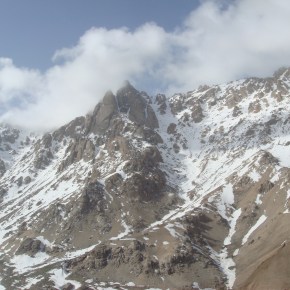
Good views along the way:

Kind of hard to tell, but the snow is starting to get really deep here:

This is the point where I stopped. I had been pushing Molly ahead with platitudes such as “It can’t be that much farther” or “Let’s just go a little more” or “I think I can see the top ahead”, but the trail was becoming very difficult to follow, it was starting to get dark and I was responsible for the lives of two others. As goal-oriented as I am, if I had been by myself, I would have pushed on regardless of whether I had to spend the night out there or not. However, my safety standards go way up when I’m looking after others:

Honey forged on without hesitation for the entirety of the climb, but started having problems on the way back. I had to carry her for long stretches and I can assure you that it is not easy to carry 60 pounds of soaking wet and unbalanced dog:

Molly scaling a snowbank blocking the trail on the way back down… She definitely hated me again at this point:

I may have lost this round with Rattlesnake Peak, but I’ll be back:

Khyber Pass to Kabul

After several days stuck in Peshawar, Pakistan because of heavy fighting in the Khyber Pass, we finally got the green light to move through very early in the morning. Tensions were running quite high as the tribesmen had been killing each other only hours before and were still freely roaming around the area with twitchy trigger fingers and guns in their hands…

The government has very little control in the tribal areas. As such, we had an armed guard in our mini bus with us and a convoy of soldiers behind us. However, we still had to disguise ourselves in native garb and close the curtains on all the windows in the mini bus… As such, I apologize for the lesser quality photos in the first part of this post. We were under strict security conditions and I didn’t want to get the other members of our group killed. So, these first pictures were all taken on the sly and quite rapidly which, unfortunately, usually reduces quality…

The famous gateway to the Khyber Pass… This is even on the currency.

Lots of traffic was backed up because the Khyber Pass had been closed for so long and many people were desperate to get through having been without food or water for several days…

A warlord’s compound strategically located on a hill overlooking the road…

A benign-looking scene along the Khyber Pass…

Not exactly like a drive to your local grocery store… We received mixed accounts as to whether this bridge was blown up or had simply been washed out.

Railroad bridge… The railroad looks fine here, but higher up, large sections have been washed away, just leaving rails hanging out over a void. It’s an interesting sight.

Another warlord’s compound…

And yet another…

This is only the side entrance to the massive compound of what is said to be one of the richest men in Pakistan… How did he make his immense fortune? Counterfeiting U.S. currency, of course…

Trucks grinding down to the border crossing at Torkham…

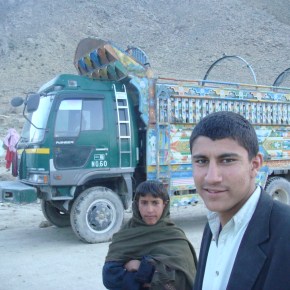
One sees all sorts of transportation arrangements…

A Khyber Rifles guard with a Khyber Rifles outpost in the background…

The armed guard that was in our vehicle…

A child begging near the border crossing (Yes, I gave her some money)…

Another child begging…

This is another beggar and he was a little dictator – shoving the other children out of the way and hitting them so he could be first in line to beg from us…

Tribal fighters…

U.S. Troops on the Afghanistan/Pakistan border at Torkham…

By the way, I have to thank Nigel for these pictures. I had some great pictures of my own, but as we were passing through the fortified border checkpoint, I was a little too obvious about snapping a picture of the CIA field officer that was present (it was a great picture, too) and immediately was surrounded by armed Americans that made me delete all pictures I had taken of the area. Fortunately, Nigel was a little more discreet.

More U.S. Soldiers…

The Torkham border crossing…

As soon as we crossed in Afghanistan, the road was lined with these cargo containers… People live in these and have small businesses inside them – feeding off of the border traffic…

Starting out on the highway toward Kabul…

The first police checkpoint we came to. One of many, many police checkpoints we would pass through… This particular group didn’t hit us up for some baksheesh, but that is a frequent occurrence.

JALALABAD

Not a nice place… This was the one time on the entire trip when my “I need to get the fuck out of here” instinct kicked in. This is still a Taliban stronghold and an oppressive tension filled the air. The beggars swarmed over us – ripping and tearing at our clothing and trying to pull us down. The women were the most physically aggressive and vicious.

Jalalabad street scene…

Knife dealers…

I thought these graphics I photographed on a rickshaw while driving out of town summed up Jalalabad pretty well…

Headed up the Kabul Gorge…

Passing a camel train…

An unintentional self-portrait taken in the Kabul Gorge… The clothing I’m wearing is part of my shalwar kameez that I was required to wear for the morning crossing through the Khyber Pass (without the camera and sunglasses, of course). The clothing is very functional and comfortable.

We literally came to a fork in the road as the main route into Kabul was closed (due either to a bombing or road construction – we were never able to determine which story was the truth).

So, we and everyone else wishing to get to Kabul, had to take this back road into the capital…

The flag you see alongside the road is a martyr’s flag… When someone is killed in battle (martyred) a flag is placed in their honor where they fell. One can determine the size of a battle by the number of martyr’s flags strewn across an area and can determine the significance of the person killed by the volume of the flags…

Another view of the road we were on…

This is what the driving was like – dodging and weaving through big trucks on blind corners…

If you think it is difficult to see, well, you’re right… Now mix in the fact that you’re driving in Afghanistan which is sporty even when you can see where you’re going…

You always have to be ready for zipping around a corner and coming across something like this old boy losing control of his donkeys…

Picture A: The road is collapsing out from under the truck… And it is difficult to tell, but the guy at the back of the truck was riding there and he is bailing out…

Picture B: The results…

Driving through the mountains…

We stopped briefly at this camp… These lads have an innovative automotive services business (You can tell they do work on vehicles by the fact that they have tires attached to the building. If someone has tires stacked or attached next to a building, that is a code indicating that they work with vehicles). The business consists solely of blowing the accumulated road dust out of air filters utilizing the air compressor you see pictured here…

Other travelers stopped at the camp…

Some of the occupants posing with their machine gun…

Kabul’s OMAR Mine Museum (or OMAR Land Mine Museum depending on whom you ask)…

Next time you’re in Kabul, Afghanistan, one place I strongly suggest checking out (if you have not already done so) is the OMAR Mine Museum. OMAR is an acronym for Organization for Mine Clearance and Afghan Rehabilitation. Now, if you go by what the OMAR home page says or by what you might find online, you will be misled into thinking that you can’t visit the OMAR Mine Museum by quotes such as this:

“For security reasons, the OMAR Mine Museum is not open for casual visitors. All appointments must be made through the main OMAR office.”

Not true. As with most things in Afghanistan, just ignore the official rules and do what you think is best. Of course, be polite about it and be prepared to pay a little baksheesh if needed… However, I just showed up at the museum and had no trouble at all. The museum director himself came out to visit me and gave me a personal tour of the interior and exterior of the museum. A very nice guy…

And here’s a picture of the very nice guard at the gate… He saw me taking a picture as I was leaving and he started yelling across the courtyard at me. I thought I was getting in trouble for taking pictures of the security measures at the museum, but it turned out that he just wanted me to take his picture as well.

And then here are some pictures from inside the OMAR Museum… The museum director told me that these are all things OMAR employees have found out in the field.

The walls of the museum are lined with rockets and other tools of war:

The classic demining outfit:

The tools of the demining trade – metal detectors, protective gear, probes, etc.

Not that the gear pictured above makes it a safe profession. Each piece of the gear pictured below belonged to an OMAR employee or volunteer killed in the field. Yes, every little item below belonged to a different person that was killed:

An Afghan war rug depicting many of the nasties that OMAR personnel contend with:

A Misnay Schardin Shaped Charge (designed for a belly attack) linked by detonating cord to an anti-tank mine supplied by the CIA to the mujahideen.

Diameter 185 mm
Height 80 mm
Explosive Charge: 1.5 kgs approx. C4 Plastic explosive

A large display of land mines… The plastic mines are unpleasant to locate because the metal detectors obviously don’t work on them. One must feel around for them.

Most mines are antipersonnel devices, cheap, small and designed to maim rather than kill. A wounded soldier is a bigger drain on the enemy than a dead one. Some mines are put just under the ground to blast up while other mines are used above ground to spray debris. These mines are usually planted to protect camps, set ambushes or slow down pursuing soldiers. Typically they use a trip wire and are never marked or documented.

A mine contains extremely explosive material that creates a wall of air and debris that expands outward at almost 7,000 meters a second. Some mines add metal projectiles like ball bearings, sharp flechettes or even nails that puncture flesh and shred bones into a fine spray. The shock waves are so strong that many victims find their feet still in their shoes and their bones turned into projectiles that kill other people.

Some of the triggers on the various land mines taken out of “service” by OMAR:

Bricks of TNT:

A large anti-tank IED (Improvised Explosive Device) made by the Mujahideen in 1984 or 1985 from a pressure cooker containing 25 kilograms of explosives. Found by OMAR Manual Mine Clearance Team D on February 16th, 2004 in the Adraskan District which is part of the Herat Province.

Coordinates North – 33 41 281 East – 062 16 546

OMAR also does a lot of work with unexploded ordnance (UXO) such as these rockets:

Or these which include a nice selection of mortars:

An innovative booby trap OMAR defused:

The classic Molotov Cocktail – everyone’s favorite:

Some of the AK-47 variations out there:

The Punt Gun is basically a very large shotgun which can be up to 1.5 inch caliber (38 mm), with a cartridge containing up to 1 kilogram of lead birdshot.

Traditional Afghan rifles:

The OMAR Mine Museum is not just an inside exhibition though. There’s a hell of a display of equipment outside as well…

Starting with this jet parked in the parking lot. What do you park next to at the end of your daily commute to work? By the way, remember what I said about the OMAR museum director telling me that everything here was stuff they found out in the field?

Certainly not the only aircraft on the grounds of the museum…

A modern jet with old cannons underneath – an interesting juxtaposition of the old and the new:

Another fighter jet:

A Soviet helicopter gunship. These were devastating to the Afghan fighters until the United States began supplying them with SAM (Surface to Air) missiles such as the famous Stinger:

Another view:

Slightly older aircraft:

One area I found particularly interesting was a display of Soviet rocketry…

Soviet rocketry – these were BIG:

Soviet rocket engines:

War machinery lining the walls of the compound:

Heavy artillery:

I had this picture taken of me to demonstrate the size of some of the artillery shells:

Rocket launchers – usually attached to a vehicle such as a helicopter:

A U.S. 500 pound bomb

Mk 82 GPLD (General Purpose Low Drag) HE Guided Bomb deflagrated in Kabul in November 2001.

As I stated above, the OMAR Mine Museum really is worth a visit. The employees are great, you get to see a lot of interesting things and they (OMAR) are doing good work. Regardless of one’s feelings on a particular conflict, it’s tough to make a case for indiscriminately strewing land mines around. They stay around long after a conflict has ended and are not picky in whom they maim or kill be it animals or children minding their own business or whomever…

Salang Pass, Salang Tunnel and The Last Battle

Many people seem to have the impression that Afghanistan consists of nothing more than sterile deserts. A drive through the Salang Pass will go a long way in dispelling that image. Along the way, the Hindu Kush mountains (through which the Salang Tunnel passes) I was reminded of everything from the Italian Alps to the Eastern Sierras… The air is rather thin and cold at the summit of the Salang Pass, more than 3,000 meters above sea-level.

Heading out from Kabul and getting up into the Hindu Kush mountains… This reminded me of the Italian Alps:

This is a tough place to scratch out an existence. We were here in late April on a sunny day and it was biting cold. I can’t imagine what the winters are like, but the numerous indications of intense avalanches and from everything I have heard, they are brutal. Home on the edge:

I thought this was an interesting home squeezed between the road and the river:

As with most of Afghanistan, the people that live here are just awesome.

I snapped this out the car window to give a sense of the people and scenery. The old boy on the end has a falcon perched on his hand:

This man had quite a story… His mother, wife and son were gunned down by Soviet troops in a punitive response to an attack on a nearby Soviet convoy. This left him with only two daughters. The Taliban took care of them after it was determined they had spoken out against the Taliban occupation. Because he had not done more to keep his daughters in line, he was subjected to horrific torture to help “re-educate” him. All alone now, he told me that he treks for days at a time in the high peaks of the Hindu Kush to cope with his loneliness:

This is what a cargo container looks like after it has been stuffed full of prisoners and had a fragmentation grenade tossed inside. It’s also been popular to stuff the cargo containers full of prisoners and simply machine gun the sides. Apparently, the bullets ricochet around inside and one doesn’t need to use as many bullets as would be required if the prisoners were simply lined up and executed. A very economical use of the resources… One stumbles across quite a few such relics from Afghanistan’s seemingly continuous conflicts.

The Salang Pass area has been a theater of conflict for decades now. In the 1980s, the Russian forces occupying Afghanistan were repeatedly ambushed by the Mujahideen when traveling through this region, while more recently this was a front-line between the Taliban and the Northern Alliance.

Anti-tank mines remain a problem alongside the road (often within one or two meters of the main road), although groups like the HALO Trust are doing much to improve this situation… Progress is slow, however, as depending on the season, the ground is either baked rock-hard or frozen rock-hard, making the task of unearthing the mines rather more difficult:

Crawling up the Salang Pass toward the summit:

The view towards Kabul from the summit:

Driving through the pass:

Some of the peaks around the summit… These were taken right outside the Salang Tunnel. The Salang Tunnel was constructed by Soviet engineers in the 1960s to give Afghanistan a much-needed north-south road artery and supply route while seeking to curry favor with the Afghan government.

After the Soviet Union invaded Afghanistan, the Salang Highway became the principal military supply route linking Kabul with the southern Soviet republics. The Soviets paid a high price to keep this road open as one can tell from the countless tanks and APCs, scarred with bullet and rocket fire, still rusting away by the side of the road…

One example from 1982: A fuel tanker in a military convoy exploded inside (the cause of the explosion remains somewhat in doubt with the Russians still claiming it was an accident and the Mujahideen still claiming it was a successful attack) the Salang Tunnel, unleashing a chain reaction of fiery explosions and death. Drivers of cars, trucks and buses evidently continued to enter the tunnel after the explosion. Soviet troops, fearing that the explosion might have been a rebel attack, closed off both ends with tanks, trapping many inside. Some burned to death; others were killed by smoke and by carbon monoxide escaping from vehicles whose drivers kept their engines idling to stay warm in the freezing cold. As many as 700 Soviet troops and 2,000 Afghan soldiers and civilians may have died.

Both ends of the Salang Tunnel were blown up by the forces of the late Ahmed Shah Masood in the 1990s in an effort to stop the Taliban advancing northwards.

Entrance to the Salang Tunnel – headed towards Kabul… Once you get inside and away from the light provided by the outside world, it doesn’t matter that one has their headlights on. You’ll still only be able to see a few meters in front of the vehicle. The lights make no difference through the cloud of dust and exhaust fumes which makes the drive more exciting because there are massive holes inside and the road is water-logged in some places:

Driving up to the tunnel entrance (driving in the direction toward Kabul):

Entering the tunnel:

This is the road sign you see when you exit the tunnel heading away from Kabul. We were headed to Pul-i-Khumri on this day… Pul-i-Khumri housed a major Soviet base at one time. Now when you drive by, there are just a few hollowed out buildings and some ripped up tarmac. It made me wonder if the legacy of Americans in Afghanistan will be reflected in the same way.

The weather here is rather volatile… This was taken just minutes after the pictures in the bright sun:

Chill Out – An Ice Bar In Dubai…

It feels a little schizophrenic to travel from a war zone in Afghanistan where there were literally firefights in the street when I was leaving (more on that in future posts) to shopping for expensive clothing and hanging out at an ice bar in Dubai just a few hours later…

Fortunately, embracing such ambiguities in life has never been a problem for me and so I soon adjusted and made the most of my time in Dubai. And I have to say that when you’re sunburned and it’s really freakin’ hot outside that it feels pretty good to slip into an environment that maintains a constant temperature below freezing.

This is my glass after one drink. After the next drink, I was unable to resist chewing the ice my glass was made out of…

Everything is made out of ice – the walls, the bar top, the couches, the art, the glasses, the stools – everything…

All of this ice is imported from Canada…

Everyone that knows me knows that I enjoy watching (but not always participating in) wretched excess… Excess is what Dubai is all about. It fuels the city.

The underprivileged and uncool in the outside world gaze in envy through the ice sculptures at the hipsters in Chill Out through these windows…

The skyline of Dubai… It’s really a good thing that this sculpture is made out of ice since the horizon in Dubai changes so quickly.

How else would you know you were in Dubai if they didn’t have ice camels?

Here’s a video panorama of the bar… I shot this right after a big group left, so Chill Out was temporarily primed up for some video documentation. This is not, however, a normal state of affairs in terms of occupancy…

Weapons Smuggling in Pakistan: Killing is my business… And business is good!

Down this innocuous looking street pictured below, in a quiet industrial area of Peshawar, Pakistan, lies a cutting-edge operation, global in nature, acutely reflective of the latest trends in world politics… An operation with far more influence in the world than its relatively small size or remote location would suggest. An operation the likes of which, many governments and various NGOs have struggled to close down. I was only here because of a very well-connected contact in Pakistan. And even as such, he was told to never bring visitors again. I promised not to reveal the location and I stand by that commitment.

This modest sign is the only marker that there is even a business located here:

Behind these gates:

You see, this is a gun smuggling operation… The organization is vertically integrated to maintain a consistent product and to be able to respond as quickly as possible to customer demands. The weapons are manufactured and shipped out from this facility, so that control is maintained over every aspect of production and distribution. Bribes are paid to the appropriate police officials and politicians (a cost of doing business) and access to suppliers of raw materials is kept close watch of.

The owner/manager of this facility is quite pleasant and hospitable. Over a cup of green tea, I asked him how business was…

He chuckled and replied, “Killing is my business…And business is good!” I don’t know if he knew this is the title to a 1985 Megadeth album, but the irony of the statement was not lost on me…

Displaying a remarkable knowledge of current events, frequently knowing in advance of many intelligence agencies and news media where violence will break out in the near future based on the level of arms shipments to the region, I’m sorry we don’t have someone like this on the payroll of the CIA rather than trying to shut them down.

The raw materials of death start here – the first workshop where slabs of stainless steel are shaped and molded:

This lad is drilling steel:

Into the basic handgun form:

These shavings are from drilled steel, and are melted down and reused:

Polishing down the newly crafted gun frames:

Manufacturing components:

Moving on to the next workshop, where the just manufactured parts are assembled, you descend these stairs:

Into this basement:

Assembling an assault weapon:

For 20,000 rupees (about $350) you could have one of your own:

Components waiting to be assembled:

Assembling the handguns:

A load of weapons ready to ship out to Nigeria – disguised as another product:

Out on the test range:

I felt compelled to do a little quality control test firing of my own with this shotgun… We can’t have customers receiving an inferior product can we?

Brandon Boers, with his trained eye, was later able to determine that the gun I am using is a copy of the Saiga-12.

****

I’m not going to moralize about what these people are doing. This is life. Killing and conflict are a component of life and likely always will be. Shut this operation down and plenty of others will spring up to replace it.

Appreciate the insight into a slice of life one rarely sees…